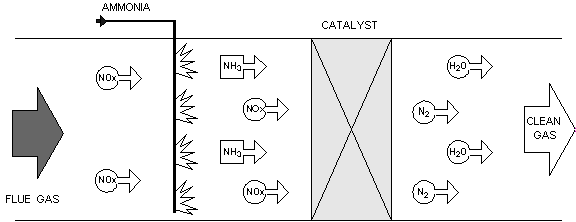
*FGV = Flue Gas
Volume
Constants from this equation were multiplied together
to produce a single constant.
| k = 1.337 x 0.5813 = 0.000000772 kg/m3 |
The equation was
rearranged replacing the engineering units with
generic labelling to represent our interest. NO
analysers not NOx analysers were installed on the
process therefore the equation became:
(NOin - NOout)
(1.111) x FGV x k = NH3/h
The equation was
accurate for steady state conditions, but did not
predict the dynamic process behaviour. The equation
was converted to a deviation equation.
| (NOout - NOin) |
- |
NH3
FGV x K 1.111
|
= |
0 |
This equation still
assumed an infinite time to complete the reaction,
where as the catalyst was sized to promote the reaction
time to convert 85% of the NOx as the flue gas passed
over the catalyst bed.
Dynamic
Equation
Representing the
rate of change from a steady state by
the deviation equation
became:
|
dNO
DT
|
= |
kp((NOin - NOout) |
-
|
NH3
FGV x k
|
)6.6666 |
Rearranging to represent the NOout in terms of NOout
deviations and NH3 ppm. The process
model differential equation became.
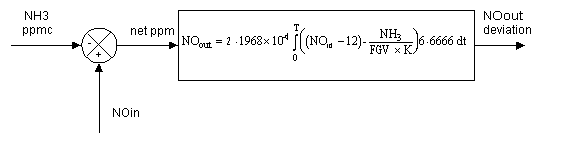
Frequency
Domain Equation
Having developed
the process equation, our interest was to design
a control system. The output from a controller is
dynamic and can be considered sinusoidal. To obtain
conditionally stable control the time delays between
the input and the output of the process must be
know. Frequency Domain modelling allowed the response
of the system to a sinusoidal input to be modelled
and time delays to be modelled as phase shifts.
The process was essentially linear therefore the
relationship between the output and the input at
a frequency was represented as the ratio of the
steady state output amplitude to the input amplitude.
Xo
Xi |
= |
output_amplitude
input_amplitude |
with a phase shift of the output
relative to the input |
A sinusoidal input
to the process would result in a differentiated
sinusoidal output. Representing the input as an
error from the steady state that must lead the output
the differential equation can be modified as:
|
((NOin - NOout)
|
- |
NH3
FGV x k |
)6.6666
|
sinwt+Ø
|
This can be represented
as E sinwt+Ø. The output dNOout/DT requires
differentiating, the sinusoidal becomes:
using the j operator
to represent a 90° rotation anticlockwise the
above can be substituted by jw. The error from the
steady state E is now represented as a phasor containing
both amplitude and phase (phasors are represented
in bold)
NOout
jw = 0.00021968 (E)
The time taken
from opening the ammonia valve to measuring a change
in NOout was 215 seconds. Modelling in the form
of exp(-jTLw) and rearranging
to form a transfer function, the transfer function
of the process was:
|
NOout
E
|
= |
0.00021968 exp(-215jw)
jw
|
For examples of
the control system and calculations associated with
this model click on one of the pages below
These calculations
are entirely original, developed by G&L Engineering.
© 2000 G&L Engineering Ltd.